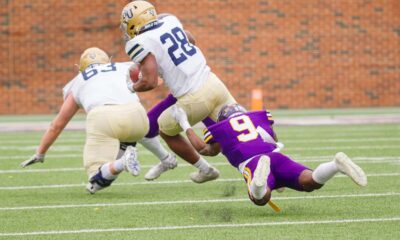
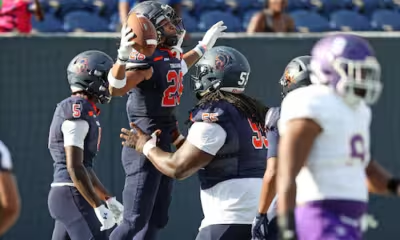
INDIANAPOLIS, INDIANA — Marian University abruptly withdrew from its NAIA Football Championship Series quarterfinal against Keiser this week after discovering that a player who competed earlier in the season was academically ineligible. The decision, announced Thursday, immediately ended the Knights’ postseason run and sent Keiser forward by forfeit — a rare and dramatic development that reverberated across the small-college football landscape.
Marian officials said the violation surfaced during an internal academic review conducted earlier in the week. Once confirmed, the university self-reported the issue to the NAIA and removed itself from championship play, citing the risk of significant retroactive penalties if the team continued competing. In the statement released through the Marian Athletics Department, the university acknowledged the weight of the decision, saying, “We regret the impact this has on our student-athletes, coaches, and supporters, but once the eligibility concern was verified, we had an obligation to act.” The school also extended formal apologies to Keiser, the NAIA national office, and members of the Marian community.
The choice was rooted in academic compliance rather than strategic concession. The player at the center of the violation had already appeared in multiple regular-season contests, and continuing to compete with him on the roster could have exposed Marian to some of the most severe penalties in college athletics: vacated wins, erased playoff results, and long-term reputational impact. Marian signaled that avoiding that outcome — both for the integrity of the record book and the credibility of the institution — was the determining factor. As the university added in its statement, “Our commitment to eligibility standards is essential to who we are. We will learn from this and ensure it does not happen again.”
Such a mid-postseason withdrawal is almost unheard of in collegiate sports. Historically, academic-eligibility cases tend to be discovered after a season is over, leading to retroactive sanctions rather than preemptive exits. Florida State’s 2006 campaign, which ended with 12 vacated wins following academic misconduct involving online coursework, remains one of the most prominent examples. Memphis basketball’s 2007 season — wiped from the books after Derrick Rose’s SAT score was invalidated — is another. Minnesota’s mid-1990s academic scandal further demonstrated how deeply such violations can scar a program, erasing multiple years of competition and tainting a Final Four run. Each case involved athletes later ruled academically ineligible; in each, the punishment came long after the games were played, and the reputational fallout extended far beyond the court or field.
That history loomed large over Marian’s decision. By withdrawing before competing, the Knights avoided the retroactive erasure that has derailed other programs. Administrators acted quickly, aware that continuing to play could jeopardize not only this season, but potentially the program’s broader competitive record. Though the school declined to publicly name the ineligible player, officials described the outcome as “deeply disappointing” internally, according to the athletics department release, but maintained that preserving institutional integrity demanded decisive action.
Keiser, which now advances automatically to the NAIA semifinals, acknowledged Marian’s decision through its athletics release and confirmed its preparation for the next round. The sudden change gives the Seahawks an unexpected bye week, while it sends Marian into offseason evaluation.
Behind the scenes, Marian has already begun a full review of its academic certification procedures. University officials said this audit will focus on strengthening communication between academic services, compliance staff, and coaching personnel — a process common across college athletics programs that face eligibility complications. The goal, they said, is not only to prevent future missteps but to reinforce academic accountability as a core part of the institution’s athletic identity.
Though the season ends at 10–2, Marian’s leadership views the decision as a painful but necessary action — one that sacrifices immediate postseason opportunity in exchange for avoiding a stain that could linger on the program for years. A postseason withdrawal is difficult; a vacated season is permanent. For Marian, the distinction was clear, and the course of action, however disappointing, had to reflect the lessons taught repeatedly throughout the history of academic compliance in college sports.
The NAIA confirmed the bracket adjustment after Marian’s withdrawal but has not indicated whether further review or sanctions will follow. For now, the Knights shift into reflection and reform, while Keiser moves forward and the NAIA playoff field reshapes around one of the most unusual postseason developments in recent memory.

Jonathan Brown started SPCSN in 2018 as a sports highlight company and started with doing videos for friends and teammates at his Alma Mater Johnson University Florida. As he progressed as an athlete and sports broadcaster in college, he began to see a need for many small colleges and semi-professional teams. He became fascinated with local team markets and wanted to show the whole world what these teams showed. In 2019, Brown transitioned his business into a sports network focused on non-NCAA DI schools, semi-professional sports, and select minor/development leagues. Brown currently serves as the CEO and chairman of the board.